 |
EqWorld The World of Mathematical Equations |
 |
Education > Partial Differential Equations (Mathematical Physics Equations) > First-Order Linear and Quasilinear Partial Differential Equations
First-Order Linear and Quasilinear Partial Differential Equations
1. General form of first-order quasilinear PDE
A first-order quasilinear partial differential equation with two independent variables has the general form

| (1) |
If the functions
 ,
,
 ,
and
,
and
 are
independent of the unknown
are
independent of the unknown  ,
then equation (1) is called linear.
,
then equation (1) is called linear.
2. Characteristic system. General solution
Suppose that two independent integrals,

| (2) |

| (3) |

| (4) |
 is
an arbitrary function of two variables. With equation (4) solved for
is
an arbitrary function of two variables. With equation (4) solved for
 ,
one often specifies the general solution in the form
,
one often specifies the general solution in the form
 ,
where
,
where
 is
an arbitrary function of one variable.
is
an arbitrary function of one variable.
Remark. If
 ,
then
,
then
 can
be used as the second integral in (2).
can
be used as the second integral in (2).
Example. Consider the linear partial differential equation
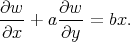 The associated characteristic system of ordinary differential equations
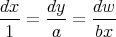 has
two integrals
has
two integrals
 ,
,
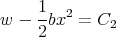 .
Therefore, the general solution to this PDE can be written as
.
Therefore, the general solution to this PDE can be written as
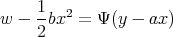 ,
or
,
or
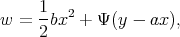 where
where
 is
an arbitrary function.
is
an arbitrary function.
3. Cauchy Problem: Two Formulations. Solving the Cauchy Problem
Generalized Cauchy problem: find a solution
 to
equation (1) satisfying the initial conditions
to
equation (1) satisfying the initial conditions

| (5) |
 is a
parameter
is a
parameter
 and
the
and
the
 are
given functions.
are
given functions.
Geometric interpretation: find an integral surface of equation (1) passing through the line defined parametrically by equation (5).
Classical Cauchy problem: find a solution
 of
equation (1) satisfying the initial condition
of
equation (1) satisfying the initial condition

| (6) |
 is a
given function.
is a
given function.
It is often convenient to represent the classical Cauchy problem as a generalized Cauchy problem by rewriting condition (6) in the parametric form

| (7) |
Existence and uniqueness theorem. If the coefficients
 ,
,
 ,
and
,
and
 of
equation (1) and the functions
of
equation (1) and the functions
 in (5) are continuously differentiable with respect to each of their arguments and
if the inequalities
in (5) are continuously differentiable with respect to each of their arguments and
if the inequalities
 and
and
 hold along a line (5), then there is a unique solution to the Cauchy problem (in a
neighborhood of the line (5)).
hold along a line (5), then there is a unique solution to the Cauchy problem (in a
neighborhood of the line (5)).
4. Procedure of solving the Cauchy problem
The procedure for solving the Cauchy problem (1), (5) involves several steps.
First, two independent integrals (2) of the characteristic system (3) are
determined. Then, to find the constants of integration
 and
and  ,
the initial data (5) must be substituted into the integrals (2) to obtain
,
the initial data (5) must be substituted into the integrals (2) to obtain

| (8) |
 and
and
 from (2) and (8) yields

| (9) |
 from relations (9), thus obtaining the solution in an explicit form.
In the cases where first integrals (2) of the characteristic system (3) cannot be found using analytical methods, one should employ numerical methods to solve the Cauchy problem (1), (5) (or (1), (6)).
Example. Consider the Cauchy problem for Hopf's equation
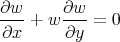
| (10) |
First, we rewrite the initial condition (6) in the parametric form (7). Solving
the characteristic system
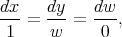 we
find two independent integrals,
we
find two independent integrals,

| (11) |
Using the initial conditions (7), we find that
 and
and
 .
Substituting these expressions into (11) yields the solution of the Cauchy problem
(10), (6) in the parametric form
.
Substituting these expressions into (11) yields the solution of the Cauchy problem
(10), (6) in the parametric form

| (12) |

| (13) |
 -plane with slope
  which intersect the
 -axis at the points
  . On
each characteristic, the function
. On
each characteristic, the function  has
the same value equal to
has
the same value equal to  (generally,
  takes different values on different characteristics).
For
 ,
different characteristics do not intersect, and hence, formulas (12) and (13) define
a unique solution.
,
different characteristics do not intersect, and hence, formulas (12) and (13) define
a unique solution.
References
- A. D. Polyanin, V. F. Zaitsev, and A. Moussiaux, Handbook of First Order Partial Differential Equations, Taylor & Francis, London, 2002.
- E. Kamke, Differentialgleichungen: Lösungsmethoden und Lösungen, II, Partielle Differentialgleichungen Erster Ordnung für eine gesuchte Funktion, Akad. Verlagsgesellschaft Geest & Portig, Leipzig, 1965.